Sponsor

Advertisment

CCNA 2 Chapter 11 v5 Exam Answers 2016

Saturday, May 7, 2016

CCNA 2 Chapter 11 v5 Exam Answers 2016


You can download fresh questions. Daily updated. 

LAST UPDATE: TODAY 


1 
Which version of NAT allows many hosts inside a private network to simultaneously use a single inside global address for connecting to the Internet?
dynamic NAT
port forwarding
PAT*
static NAT
2 
What is the group of public IPv4 addresses used on a NAT-enabled router known as?
inside local addresses
outside global addresses
inside global addresses*
outside local addresses
3
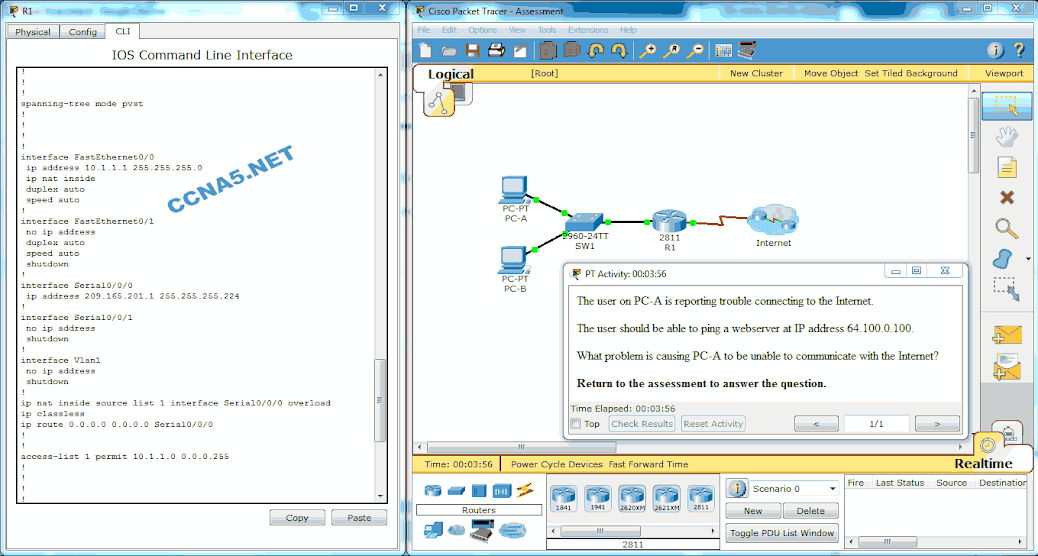
Launch PT  Hide and Save PT
Open the PT Activity. Perform the tasks in the activity instructions and then answer the question.
What problem is causing PC-A to be unable to communicate with the Internet?
The access list used in the NAT process is referencing the wrong subnet.
The static route should not reference the interface, but the outside address instead.
The NAT interfaces are not correctly assigned.*
This router should be configured to use static NAT instead of PAT.
The ip nat inside source command refers to the wrong interface.
4 
What is a disadvantage of NAT?
There is no end-to-end addressing.*
The internal hosts have to use a single public IPv4 address for external communication.
The router does not need to alter the checksum of the IPv4 packets.​
The costs of readdressing hosts can be significant for a publicly addressed network.​
5 
Which statement accurately describes dynamic NAT?
It provides a mapping of internal host names to IP addresses.
It always maps a private IP address to a public IP address.
It provides an automated mapping of inside local to inside global IP addresses.*
It dynamically provides IP addressing to internal hosts.
6 
When dynamic NAT without overloading is being used, what happens if seven users attempt to access a public server on the Internet when only six addresses are available in the NAT pool?
All users can access the server.
The first user gets disconnected when the seventh user makes the request.
The request to the server for the seventh user fails.*
No users can access the server.
7 
What is the purpose of port forwarding?
Port forwarding allows an external user to reach a service on a private IPv4 address that is located inside a LAN.*
Port forwarding allows users to reach servers on the Internet that are not using standard port numbers.
Port forwarding allows an internal user to reach a service on a public IPv4 address that is located outside a LAN.
Port forwarding allows for translating inside local IP addresses to outside local addresses.
8
Refer to the exhibit. What has to be done in order to complete the static NAT configuration on R1?
R1 should be configured with the command ip nat inside source static 209.165.200.1 192.168.11.11.
R1 should be configured with the command ip nat inside source static 209.165.200.200 192.168.11.11.
Interface S0/0/0 should be configured with the command ip nat outside.*
Interface Fa0/0 should be configured with the command no ip nat inside.
9 
When NAT is employed in a small office, which address type is typically used for hosts on the local LAN?
Internet-routable addresses
both private and public IP addresses
private IP addresses*
global public IP addresses
10
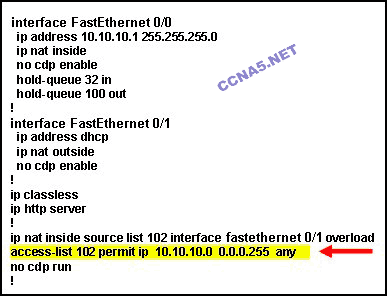
Refer to the exhibit. What is the purpose of the command marked with an arrow shown in the partial configuration output of a Cisco broadband router?
defines which addresses can be translated*
defines which addresses are allowed into the router
defines which addresses are assigned to a NAT pool
defines which addresses are allowed out of the router
11 
A network administrator configures the border router with the command R1(config)# ip nat inside source list 4 pool corp. What is required to be configured in order for this particular command to be functional?
a VLAN named corp to be enabled and active and routed by R1
an access list named corp that defines the private addresses that are affected by NAT
ip nat outside to be enabled on the interface that connects to the LAN affected by the NAT
an access list numbered 4 that defines the starting and ending public IP addresses
a NAT pool named corp that defines the starting and ending public IP addresses*
12
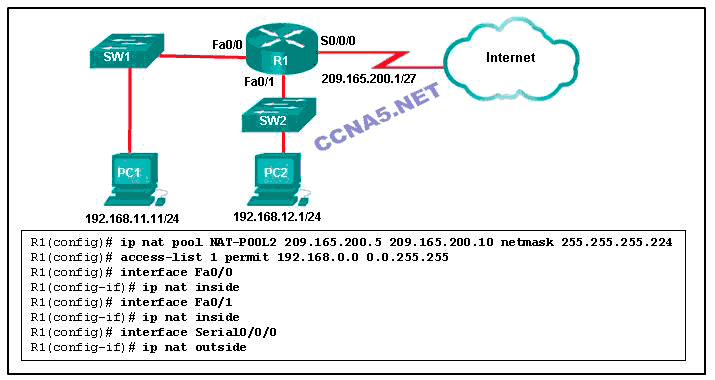
Refer to the exhibit. R1 is configured for NAT as displayed. What is wrong with the configuration?
Access-list 1 is misconfigured.
NAT-POOL2 is not bound to ACL 1.*
Interface Fa0/0 should be identified as an outside NAT interface.
The NAT pool is incorrect.
13 
A network engineer has configured a router with the command ip nat inside source list 4 pool corp overload. Why did the engineer use the overload option?
The company needs to have more public IP addresses available to be used on the Internet.
The company has a small number of servers that should be accessible by clients from the Internet.
The company has more private IP addresses than available public IP addresses.*
The company router must throttle or buffer traffic because the processing power of the router is not enough to handle the normal load of external-bound Internet traffic.
14

Refer to the exhibit. What will be the effect of entering the command that is shown in the exhibit on R2 as part of the dynamic NAT configuration?
It will bind NAT-POOL1 with ACL 1.*
It will identify an inside NAT interface.
It will define a pool of addresses for translation.
It will define the source ACL for the external interface.
15 
Which configuration would be appropriate for a small business that has the public IP address of 209.165.200.225/30 assigned to the external interface on the router that connects to the Internet?
access-list 1 permit 10.0.0.0 0.255.255.255
ip nat pool comp 192.0.2.1 192.0.2.8 netmask 255.255.255.240
ip nat inside source list 1 pool comp overload
access-list 1 permit 10.0.0.0 0.255.255.255
ip nat pool comp 192.0.2.1 192.0.2.8 netmask 255.255.255.240
ip nat inside source list 1 pool comp overload
ip nat inside source static 10.0.0.5 209.165.200.225
access-list 1 permit 10.0.0.0 0.255.255.255
ip nat pool comp 192.0.2.1 192.0.2.8 netmask 255.255.255.240
ip nat inside source list 1 pool comp
access-list 1 permit 10.0.0.0 0.255.255.255
ip nat inside source list 1 interface serial 0/0/0 overload ********
16 
Which type of NAT maps a single inside local address to a single inside global address?
dynamic
port address translation
static*
overloading
17 
Typically, which network device would be used to perform NAT for a corporate environment?
host device
router*
DHCP server
server
switch
18 
Several key servers in an organization must be directly accessible from the Internet. What addressing policy should be implemented for these servers?
Use dynamic NAT to provide addresses for the servers.
Place all of the servers in their own Class C private subnet.
Use DHCP to assign addresses from the pool of Class B addresses.
Assign static internal addresses and public external addresses to each of the servers.*
19 
What is a characteristic of unique local addresses?
They are designed to improve the security of IPv6 networks.
Their implementation depends on ISPs providing the service.
They allow sites to be combined without creating any address conflicts.*
They are defined in RFC 3927.
20
Refer to the exhibit. Based on the output that is shown, what type of NAT has been implemented?
static NAT with a NAT pool
PAT using an external interface*
static NAT with one entry
dynamic NAT with a pool of two public IP addresses
21
Refer to the exhibit. The NAT configuration applied to the router is as follows:
ERtr(config)# access-list 1 permit 10.0.0.0 0.255.255.255
ERtr(config)# ip nat pool corp 209.165.201.6 209.165.201.30 netmask 255.255.255.224
ERtr(config)# ip nat inside source list 1 pool corp overload
ERtr(config)# ip nat inside source static 10.10.10.55 209.165.201.4
ERtr(config)# interface gigabitethernet 0/0
ERtr(config-if)# ip nat inside
ERtr(config-if)# interface serial 0/0/0
ERtr(config-if)# ip nat outside
Based on the configuration and the output shown, what can be determined about the NAT status within the organization?
Static NAT is working, but dynamic NAT is not.
NAT is working.
Not enough information is given to determine if both static and dynamic NAT are working.*
Dynamic NAT is working, but static NAT is not.
22. Match the steps with the actions that are involved when an internal host with IP address 192.168.10.10 attempts to send a packet to an external server at the IP address 209.165.200.254 across a router R1 that is running dynamic NAT. (Not all options are used.)
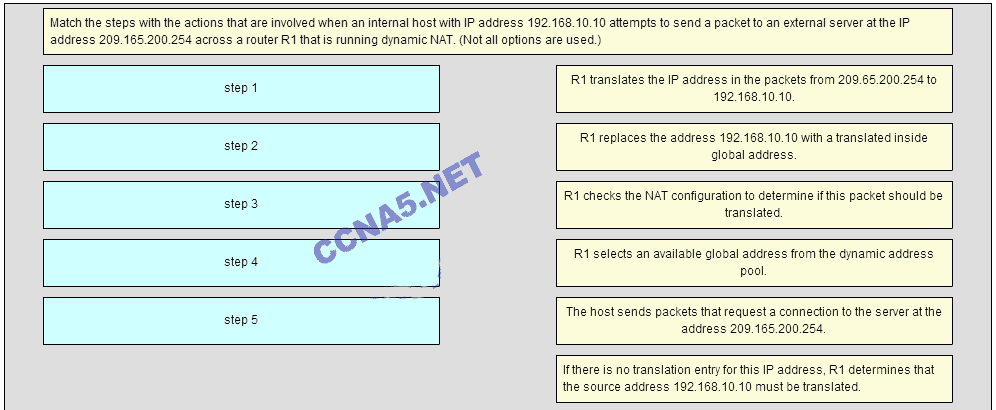
Place the options in the following order:
– not scored –
step 5 => R1 replaces the address 192.168.10.10 with a translated inside global address.
step 2 => R1 checks the NAT configuration to determine if this packet should be translated.
step 4 => R1 selects an available global address from the dynamic address pool.
step 1 => The cost sends packets that request a connection to the server at the address 209.165.200.254
step 3 => If there is no translation entry for this IP address, R1 determines that the source address 192.168.10.10 must be translated.
23 
What are two required steps to configure PAT? (Choose two.)
Define the range of ports to be used.
Define a pool of global addresses to be used for overload translation.*
Identify the inside interface.*
Define a standard access list that allow the outside global addresses to be used.
Define a standard access list denying the addresses that should be translated.
24. Using NAT terminology, what is the address of the source host on a private network as seen from inside the network?
inside local*
outside local
outside global
inside global
25. What is an advantage of deploying IPv4 NAT technology for internal hosts in an organization?
provides flexibility in designing the IPv4 addressing scheme*
increases the performance of packet transmission to the Internet
enables the easy deployment of applications that require end-to-end traceability
makes internal network access easy for outside hosts using UDP
26. A network administrator is configuring a static NAT on the border router for a web server located in the DMZ network. The web server is configured to listen on TCP port 8080. The web server is paired with the internal IP address of 192.168.5.25 and the external IP address of 209.165.200.230. For easy access by hosts on the internet, external users do not need to specify the port when visiting the web server. Which command will configure the static NAT?
R1(config)# ip nat inside source static tcp 192.168.5.25 8080 209.165.200.230 80*
R1(config)# ip nat inside source static tcp 192.168.5.25 80 209.165.200.230 8080
R1(config)# ip nat inside source static tcp 209.165.200.230 8080 192.168.5.25 80
R1(config)# ip nat inside source static tcp 209.165.200.230 80 192.168.5.25 8080
27. Fill in the blank. Do not use abbrevations.
NAT overload is also know as __Port Address Translation__
28. What is the primary purpose of NAT?
allow peer-to-peer file sharing
enhance network performance
increase network security
conserve IPv4 addresses*
Read more ...

CCNA 2 Chapter 10 v5 Exam Answers 2016

Saturday, May 7, 2016

CCNA 2 Chapter 10 v5 Exam Answers 2016

You can download fresh questions. Daily updated. 

LAST UPDATE: TODAY 


1

Refer to the exhibit. What should be done to allow PC-A to receive an IPv6 address from the DHCPv6 server?
Add the IPv6 address 2001:DB8:1234:5678::10/64 to the interface configuration of the DHCPv6 server.
Configure the ipv6 nd managed-config-flag command on interface Fa0/1.
Change the ipv6 nd managed-config-flag command to ipv6 nd other-config-flag.
Add the ipv6 dhcp relay command to interface Fa0/0.*
2 
What is the reason why the DHCPREQUEST message is sent as a broadcast during the DHCPv4 process?
for routers to fill their routing tables with this new information
to notify other hosts not to request the same IP address
to notify other DHCP servers on the subnet that the IP address was leased*
for hosts on other subnets to receive the information
3 
A company uses DHCP servers to dynamically assign IPv4 addresses to employee workstations. The address lease duration is set as 5 days. An employee returns to the office after an absence of one week. When the employee boots the workstation, it sends a message to obtain an IP address. Which Layer 2 and Layer 3 destination addresses will the message contain?
FF-FF-FF-FF-FF-FF and 255.255.255.255*
MAC address of the DHCP server and 255.255.255.255
FF-FF-FF-FF-FF-FF and IPv4 address of the DHCP server
both MAC and IPv4 addresses of the DHCP server
4 
Fill in the blank. Do not abbreviate.
Type a command to exclude the first fifteen useable IP addresses from a DHCPv4 address pool of the network 10.0.15.0/24.
Router(config)# ip dhcp ” excluded-address 10.0.15.1 10.0.15.15”
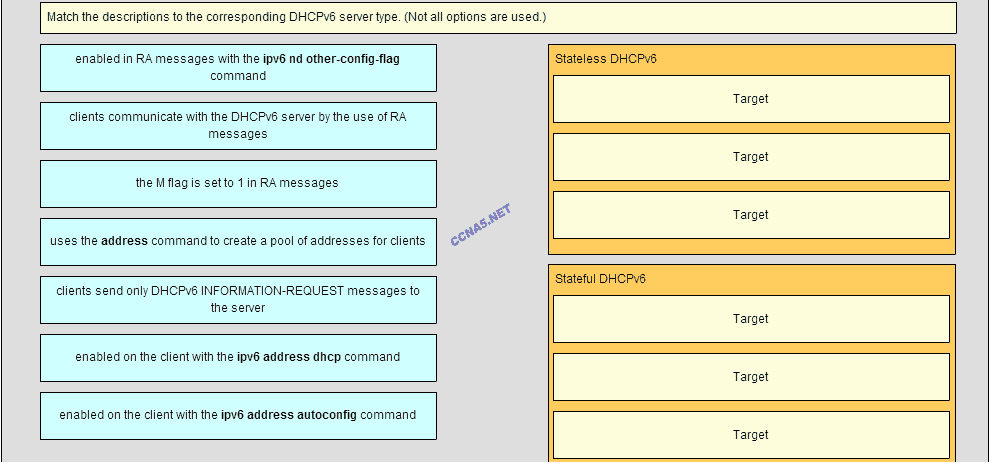
5. Match the descriptions to the corresponding DHCPv6 server type. (Not all options are used.)

Place the options in the following order:
Stateless DHCPv6
[+] enabled in RA messages with the ipv6 nd other-config-flag command 
[+] clients send only DHCPv6 INFORMATION-REQUEST messages to the server 
[+] enabled on the client with the ipv6 address autoconfig command
Stateful DHCPv6
[#] the M flag is set to 1 in RA messages 
[#] uses the address command to create a pool of addresses for clients 
[#] enabled on the client with the ipv6 address dhcp command
[+] Order does not matter within this group.
[#] Order does not matter within this group.
6

Refer to the exhibit. A network administrator is implementing stateful DHCPv6 operation for the company. However, the clients are not using the prefix and prefix-length information that is configured in the DHCP pool. The administrator issues a show ipv6 interface command. What could be the cause of the problem?
The router is configured for stateless DHCPv6 operation.*
No virtual link-local address is configured.
The router is configured for SLAAC DHCPv6 operation.
The Duplicate Address Detection feature is disabled.
7 
A network engineer is troubleshooting hosts on a LAN that are not being assigned an IPv4 address from a DHCP server after a new Ethernet switch has been installed on the LAN. The configuration of the DHCP server has been confirmed as correct and the clients have network connectivity to other networks if a static IP address is configured on each one. What step should the engineer take next to solve the issue?
Issue the ipconfig/release command on each client.
Issue the show ip dhcp binding command on the switch.
Issue the show interface command on the router to confirm that the LAN gateway is operational.
Confirm that ports on the Layer 2 LAN switch are configured as edge ports.*
8 
A network administrator configures a router to send RA messages with M flag as 0 and O flag as 1. Which statement describes the effect of this configuration when a PC tries to configure its IPv6 address?
It should use the information that is contained in the RA message exclusively.
It should contact a DHCPv6 server for the prefix, the prefix-length information, and an interface ID that is both random and unique.
It should use the information that is contained in the RA message and contact a DHCPv6 server for additional information.*
It should contact a DHCPv6 server for all the information that it needs.
9 
Which protocol supports Stateless Address Autoconfiguration (SLAAC) for dynamic assignment of IPv6 addresses to a host?
UDP
ICMPv6*
ARPv6
DHCPv6
10 
A network administrator is implementing DHCPv6 for the company. The administrator configures a router to send RA messages with M flag as 1 by using the interface command ipv6 nd managed-config-flag. What effect will this configuration have on the operation of the clients?
Clients must use the prefix and prefix length that are provided by a DHCPv6 server and generate a random interface ID.
Clients must use the information that is contained in RA messages.
Clients must use the prefix and prefix length that are provided by RA messages and obtain additional information from a DHCPv6 server.
Clients must use all configuration information that is provided by a DHCPv6 server.*
11 
Under which two circumstances would a router usually be configured as a DHCPv4 client? (Choose two.)
The router is meant to provide IP addresses to the hosts.
The router has a fixed IP address.
The router is intended to be used as a SOHO gateway.*
The administrator needs the router to act as a relay agent.
This is an ISP requirement.*
12
A company uses the SLAAC method to configure IPv6 addresses for the employee workstations. Which address will a client use as its default gateway?​
the unique local address of the router interface that is attached to the network
the global unicast address of the router interface that is attached to the network
the link-local address of the router interface that is attached to the network*
the all-routers multicast address
13
Refer to the exhibit. Based on the output that is shown, what kind of IPv6 addressing is being configured?
static link-local
stateful DHCPv6
stateless DHCPv6*
SLAAC
14 
A company implements the stateless DHCPv6 method for configuring IPv6 addresses on employee workstations. After a workstation receives messages from multiple DHCPv6 servers to indicate their availability for DHCPv6 service, which message does it send to a server for configuration information?
DHCPv6 INFORMATION-REQUEST*
DHCPv6 ADVERTISE
DHCPv6 REQUEST
DHCPv6 SOLICIT
15 
An administrator issues the commands:
Router(config)# interface g0/1
Router(config-if)# ip address dhcp
What is the administrator trying to achieve?
configuring the router to obtain IP parameters from a DHCPv4 server*
configuring the router to act as a relay agent
configuring the router to resolve IP address conflicts
configuring the router to act as a DHCPv4 server
16 
Which set of commands will configure a router as a DHCP server that will assign IPv4 addresses to the 192.168.100.0/23 LAN while reserving the first 10 and the last addresses for static assignment?
dhcp pool LAN-POOL-100
ip dhcp excluded-address 192.168.100.1 192.168.100.9
ip dhcp excluded-address 192.168.100.254
network 192.168.100.0 255.255.254.0
default-router 192.168.101.1
ip dhcp excluded-address 192.168.100.1 192.168.100.9
ip dhcp excluded-address 192.168.101.254
ip dhcp pool LAN-POOL-100
ip network 192.168.100.0 255.255.254.0
ip default-gateway 192.168.100.1
ip dhcp excluded-address 192.168.100.1 192.168.100.10
ip dhcp excluded-address 192.168.101.254
ip dhcp pool LAN-POOL-100
network 192.168.100.0 255.255.254.0
default-router 192.168.100.1 ************************
ip dhcp excluded-address 192.168.100.1 192.168.100.10
ip dhcp excluded-address 192.168.100.254
ip dhcp pool LAN-POOL-100
network 192.168.100.0 255.255.255.0
ip default-gateway 192.168.100.1
17 
Which DHCPv4 message will a client send to accept an IPv4 address that is offered by a DHCP server?
broadcast DHCPACK
unicast DHCPACK
broadcast DHCPREQUEST*
unicast DHCPREQUEST
18
Launch PT Hide and Save PT
Open the PT Activity. Perform the tasks in the activity instructions and then answer the question.
How many IP addresses has the DHCP server leased and what is the number of DHCP pools configured? (Choose two.)
one pool*
three leases*
two pools
six pools
seven leases
five leases
19

Refer to the exhibit. A network administrator is implementing the stateless DHCPv6 operation for the company. Clients are configuring IPv6 addresses as expected. However, the clients are not getting the DNS server address and the domain name information configured in the DHCP pool. What could be the cause of the problem?
The DNS server address is not on the same network as the clients are on.
The clients cannot communicate with the DHCPv6 server, evidenced by the number of active clients being 0.
The GigabitEthernet interface is not activated.
The router is configured for SLAAC DHCPv6 operation.*
20 
A host on the 10.10.100.0/24 LAN is not being assigned an IPv4 address by an enterprise DHCP server with the address 10.10.200.10/24. What is the best way for the network engineer to resolve this problem?
Issue the command ip helper-address 10.10.100.0 on the router interface that is the 10.10.200.0/24 gateway.
Issue the command default-router 10.10.200.10 at the DHCP configuration prompt on the 10.10.100.0/24 LAN gateway router.
Issue the command ip helper-address 10.10.200.10 on the router interface that is the 10.10.100.0/24 gateway.*
Issue the command network 10.10.200.0 255.255.255.0 at the DHCP configuration prompt on the 10.10.100.0/24 LAN gateway router.
21 
Which is a DHCPv4 address allocation method that assigns IPv4 addresses for a limited lease period?
pre-allocation
manual allocation
automatic allocation
dynamic allocation*
22. Order the steps of configuring a router as a DHCPv4 server. (Not all options are used.)

Place the options in the following order: 
[+] Step 2  -> Configure a DHCP pool.
[+] Step 1  -> Exclude IP addresses.
– not scored – 
[+] Step 3  ->Define the default gateway router
– not scored –

23 
An administrator wants to configure hosts to automatically assign IPv6 addresses to themselves by the use of Router Advertisement messages, but also to obtain the DNS server address from a DHCPv6 server. Which address assignment method should be configured?
RA and EUI-64
stateful DHCPv6
stateless DHCPv6*
SLAAC
24 
A company uses the method SLAAC to configure IPv6 addresses for the workstations of the employees. A network administrator configured the IPv6 address on the LAN interface of the router. The interface status is UP. However, the workstations on the LAN segment did not obtain the correct prefix and prefix length. What else should be configured on the router that is attached to the LAN segment for the workstations to obtain the information?​
R1(config-if)# ipv6 nd other-config-flag
R1(config-if)# ipv6 enable
R1(config)# ipv6 dhcp pool <name of the pool>
R1(config)# ipv6 unicast-routing*
25. Which address does a DHCPv4 server target when sending a DHCPOFFER message to a client that makes an address request?
client IP address
client hardware address*
broadcast MAC address
gateway IP address
26. What is an advantage of configuring a Cisco router as a relay agent?
It can provide relay services for multiple UDP services.*
It can forward both broadcast and multicast messages on behalf of clients.
It will allow DHCPDISCOVER messages to pass without alteration.
It reduces the response time from a DHCP server.
27. How does an IPv6 client ensure that it has a unique address after it configures its IPv6 address using the SLAAC allocation method?
It sends an ARP message with the IPv6 address as the destination IPv6 address.
It checks with the IPv6 address database that is hosted by the SLAAC server.
It sends an ICMPv6 Neighbor Solicitation message with the IPv6 address as the target IPv6 address.*
It contacts the DHCPv6 server via a special formed ICMPv6 message.
28. What is used in the EUI-64 process to create an IPv6 interface ID on an IPv6 enabled interface?
a randomly generated 64-bit hexadecimal address
the MAC address of the IPv6 enabled interface*
an IPv4 address that is configured on the interface
an IPv6 address that is provided by a DHCPv6 server
29. As a DHCPv4 client lease is about to expire, what is the message that the client sends the DHCP server?
DHCPOFFER
DHCPACK
DHCPDISCOVER
DHCPREQUEST*
Read more ...

CCNA 2 Chapter 9 v5 Exam Answers 2016

Saturday, May 7, 2016

CCNA 2 Chapter 9 v5 Exam Answers 2016

You can download fresh questions. Daily updated. 

LAST UPDATE: TODAY 


1 
A network administrator needs to configure a standard ACL so that only the workstation of the administrator with the IP address 192.168.15.23 can access the virtual terminal of the main router. Which two configuration commands can achieve the task? (Choose two.)
Router1(config)# access-list 10 permit 192.168.15.23 255.255.255.0
Router1(config)# access-list 10 permit 192.168.15.23 0.0.0.0* 
Router1(config)# access-list 10 permit 192.168.15.23 0.0.0.255
Router1(config)# access-list 10 permit 192.168.15.23 255.255.255.255
Router1(config)# access-list 10 permit host 192.168.15.23*
2

Refer to the exhibit. A router has an existing ACL that permits all traffic from the 172.16.0.0 network. The administrator attempts to add a new ACE to the ACL that denies packets from host 172.16.0.1 and receives the error message that is shown in the exhibit. What action can the administrator take to block packets from host 172.16.0.1 while still permitting all other traffic from the 172.16.0.0 network?
Manually add the new deny ACE with a sequence number of 5.* 
Manually add the new deny ACE with a sequence number of 15.
Add a deny any any ACE to access-list 1.
Create a second access list denying the host and apply it to the same interface.
3
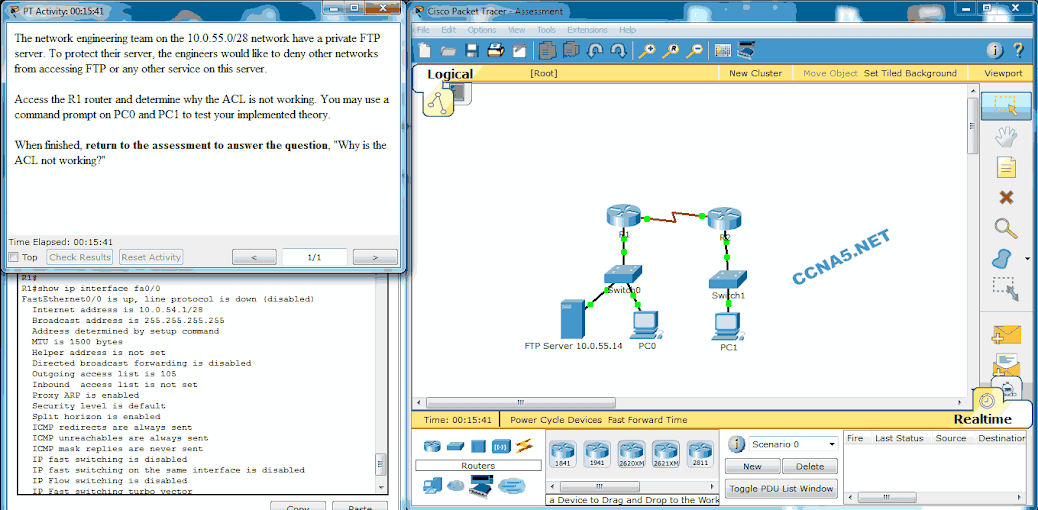
Launch PT   –    Hide and Save PT
Open the PT Activity. Perform the tasks in the activity instructions and then answer the question.
Why is the ACL not working?
The ACL is missing a deny ip any any ACE.
The ACL is applied in the wrong direction.
The access-list 105 command or commands are incorrect.
The ACL is applied to the wrong interface.* 
No ACL is needed for this scenario.
4 
Which statement describes a characteristic of standard IPv4 ACLs?
They are configured in the interface configuration mode.
They can be created with a number but not with a name.
They filter traffic based on source IP addresses only.* 
They can be configured to filter traffic based on both source IP addresses and source ports.
5

Refer to the exhibit. The network administrator that has the IP address of 10.0.70.23/25 needs to have access to the corporate FTP server (10.0.54.5/28). The FTP server is also a web server that is accessible to all internal employees on networks within the 10.x.x.x address. No other traffic should be allowed to this server. Which extended ACL would be used to filter this traffic, and how would this ACL be applied? (Choose two.)
access-list 105 permit ip host 10.0.70.23 host 10.0.54.5
access-list 105 permit tcp any host 10.0.54.5 eq www
access-list 105 permit ip any any
R1(config)# interface s0/0/0
R1(config-if)# ip access-group 105 out
R1(config)# interface gi0/0
R1(config-if)# ip access-group 105 out ******************
access-list 105 permit tcp host 10.0.70.23 host 10.0.54.5 eq 20
access-list 105 permit tcp host 10.0.70.23 host 10.0.54.5 eq 21
access-list 105 permit tcp 10.0.0.0 0.255.255.255 host 10.0.54.5 eq www
access-list 105 deny ip any host 10.0.54.5
access-list 105 permit ip any any ********************
access-list 105 permit tcp host 10.0.54.5 any eq www
access-list 105 permit tcp host 10.0.70.23 host 10.0.54.5 eq 20
access-list 105 permit tcp host 10.0.70.23 host 10.0.54.5 eq 21
R2(config)# interface gi0/0
R2(config-if)# ip access-group 105 in
6 
What are two possible uses of access control lists in an enterprise network? (Choose two.)
limiting debug outputs* 
reducing the processing load on routers
controlling the physical status of router interfaces
controlling virtual terminal access to routers* 
allowing Layer 2 traffic to be filtered by a router
7 
An administrator has configured an access list on R1 to allow SSH administrative access from host 172.16.1.100. Which command correctly applies the ACL?
R1(config-line)# access-class 1 out
R1(config-line)# access-class 1 in* 
R1(config-if)# ip access-group 1 out
R1(config-if)# ip access-group 1 in
8 
Which three statements are generally considered to be best practices in the placement of ACLs? (Choose three.)
Place extended ACLs close to the source IP address of the traffic.* 
For every inbound ACL placed on an interface, there should be a matching outbound ACL.
Place extended ACLs close to the destination IP address of the traffic.
Place standard ACLs close to the destination IP address of the traffic.* 
Filter unwanted traffic before it travels onto a low-bandwidth link.* 
Place standard ACLs close to the source IP address of the traffic.
9 
Which three implicit access control entries are automatically added to the end of an IPv6 ACL? (Choose three.)
deny icmp any any
deny ipv6 any any* 
permit icmp any any nd-ns* 
permit ipv6 any any
deny ip any any
permit icmp any any nd-na*
10 
Which two characteristics are shared by both standard and extended ACLs? (Choose two.)
Both filter packets for a specific destination host IP address.
Both can be created by using either a descriptive name or number.* 
Both include an implicit deny as a final ACE.* 
Both can permit or deny specific services by port number.
Both kinds of ACLs can filter based on protocol type.
11
Place the options in the following order:
192.168.15.65 255.255.255.240 ==> the first valid host address in a subnet
192.168.15.144 0.0.0.15 ==> subnetwork address of a subnet with 14 valid host addreses
host 192.168.15.2 ==> all IP address bits must match exactly
192.168.5.0 0.0.3.255 ==> hosts in a subnet with SM 255.255.252.0
192.168.3.64 0.0.0.7 ==> address with a subnet 255.255.255.248
12 
Consider the following access list that allows IP phone configuration file transfers from a particular host to a TFTP server:

R1(config)# access-list 105 permit udp host 10.0.70.23 host 10.0.54.5 range 1024 5000
R1(config)# access-list 105 deny ip any any
R1(config)# interface gi0/0
R1(config-if)# ip access-group 105 out

Which method would allow the network administrator to modify the ACL and include FTP transfers from any source IP address?
R1(config)# interface gi0/0
R1(config-if)# no ip access-group 105 out
R1(config)# access-list 105 permit tcp any host 10.0.54.5 eq 20
R1(config)# access-list 105 permit tcp any host 10.0.54.5 eq 21
R1(config)# interface gi0/0
R1(config-if)# ip access-group 105 out
R1(config)# access-list 105 permit tcp any host 10.0.54.5 eq 20
R1(config)# access-list 105 permit tcp any host 10.0.54.5 eq 21
R1(config)# access-list 105 permit udp host 10.0.70.23 host 10.0.54.5 range 1024 5000
R1(config)# access-list 105 permit tcp any host 10.0.54.5 eq 20
R1(config)# access-list 105 permit tcp any host 10.0.54.5 eq 21
R1(config)# access-list 105 deny ip any any
R1(config)# interface gi0/0
R1(config-if)# no ip access-group 105 out
R1(config)# no access-list 105
R1(config)# access-list 105 permit udp host 10.0.70.23 host 10.0.54.5 range 1024 5000
R1(config)# access-list 105 permit tcp any host 10.0.54.5 eq 20
R1(config)# access-list 105 permit tcp any host 10.0.54.5 eq 21
R1(config)# access-list 105 deny ip any any
R1(config)# interface gi0/0
R1(config-if)# ip access-group 105 out ******************
13 
What two functions describe uses of an access control list? (Choose two.)
ACLs provide a basic level of security for network access.* 
ACLs can control which areas a host can access on a network.* 
Standard ACLs can restrict access to specific applications and ports.
ACLs can permit or deny traffic based upon the MAC address originating on the router.
ACLs assist the router in determining the best path to a destination.
14 
Which feature is unique to IPv6 ACLs when compared to those of IPv4 ACLs?
an implicit permit of neighbor discovery packets* 
an implicit deny any any ACE
the use of named ACL entries
the use of wildcard masks
15 
Which three statements describe ACL processing of packets? (Choose three.)
Each packet is compared to the conditions of every ACE in the ACL before a forwarding decision is made.
A packet that has been denied by one ACE can be permitted by a subsequent ACE.
Each statement is checked only until a match is detected or until the end of the ACE list.* 
An implicit deny any rejects any packet that does not match any ACE.* 
A packet that does not match the conditions of any ACE will be forwarded by default.
A packet can either be rejected or forwarded as directed by the ACE that is matched.*
16 
Which statement describes a difference between the operation of inbound and outbound ACLs?
On a network interface, more than one inbound ACL can be configured but only one outbound ACL can be configured.
In contrast to outbound ALCs, inbound ACLs can be used to filter packets with multiple criteria.
Inbound ACLs are processed before the packets are routed while outbound ACLs are processed after the routing is completed.* 
Inbound ACLs can be used in both routers and switches but outbound ACLs can be used only on routers.
17 
What is the only type of ACL available for IPv6?
named standard
numbered extended
named extended* 
numbered standard
18 
Which IPv6 ACL command entry will permit traffic from any host to an SMTP server on network 2001:DB8:10:10::/64?
permit tcp any host 2001:DB8:10:10::100 eq 23
permit tcp host 2001:DB8:10:10::100 any eq 23
permit tcp host 2001:DB8:10:10::100 any eq 25
permit tcp any host 2001:DB8:10:10::100 eq 25*
19

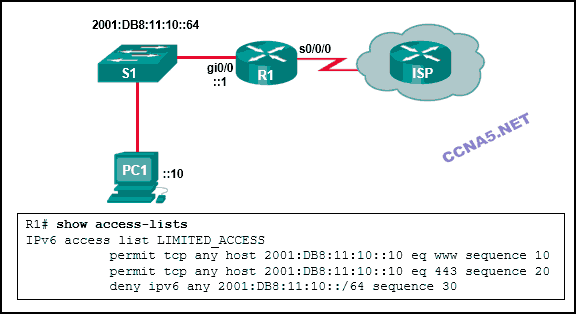
Refer to the exhibit. The IPv6 access list LIMITED_ACCESS is applied on the S0/0/0 interface of R1 in the inbound direction. Which IPv6 packets from the ISP will be dropped by the ACL on R1?
neighbor advertisements that are received from the ISP router
ICMPv6 packets that are destined to PC1* 
packets that are destined to PC1 on port 80
HTTPS packets to PC1
20 
If a router has two interfaces and is routing both IPv4 and IPv6 traffic, how many ACLs could be created and applied to it?
4
8*
6
16
12
21 . Which IPv4 address range covers all IP addresses that match the ACL filter specified by 172.16.2.0 with wildcard mask 0.0.1.255?
172.16.2.1 to 172.16.255.255
172.16.2.1 to 172.16.3.254
172.16.2.0 to 172.16.2.255
172.16.2.0 to 172.16.3.255*
22. What packets would match the access control list statement that is shown below?
+++++ access-list 110 permit tcp 172.16.0.0 0.0.0.255 any eq 22 +++++

SSH traffic from the 172.16.0.0 network to any destination network*

SSH traffic from any source network to the 172.16.0.0 network
any TCP traffic from any host to the 172.16.0.0 network
any TCP traffic from the 172.16.0.0 network to any destination network
23. What single access list statement matches all of the following networks?
192.168.16.0
192.168.17.0
192.168.18.0
192.168.19.0
access-list 10 permit 192.168.16.0 0.0.3.255*
access-list 10 permit 192.168.16.0 0.0.0.255
access-list 10 permit 192.168.16.0 0.0.15.255
access-list 10 permit 192.168.0.0 0.0.15.255
24. What is a limitation when utilizing both IPv4 and IPv6 ACLs on a router?
A device can run only IPv4 ACLs or IPv6 ACLs.
Both IPv4 and IPv6 ACLs can be configured on a single device, but cannot share the same name.*
IPv4 ACLs can be numbered or named whereas IPv6 ACLs must be numbered.
IPv6 ACLs perform the same functions as standard IPv4 ACLs.
25. In which configuration would an outbound ACL placement be preferred over an inbound ACL placement?
when the ACL is applied to an outbound interface to filter packets coming from multiple inbound interfaces before the packets exit the interface*
when a router has more than one ACL
when an outbound ACL is closer to the source of the traffic flow
when an interface is filtered by an outbound ACL and the network attached to the interface is the source network being filtered within the ACL
26. What method is used to apply an IPv6 ACL to a router interface?
the use of the access-class command
the use of the ip access-group command
the use of the ipv6 traffic-filter command*
the use of the ipv6 access-list command
27.
Refer to the exhibit. What will happen to the access list 10 ACEs if the router is rebooted before any other commands are implemented?
The ACEs of access list 10 will be deleted.
The ACEs of access list 10 will not be affected.
The ACEs of access list 10 will be renumbered.*
The ACEs of access list 10 wildcard masks will be converted to subnet masks.
28.
Refer to the exhibit. What is the result of adding the established argument to the end of the ACE?
Any traffic is allowed to reach the 192.168.254.0 255.255.254.0 network.
Any IP traffic is allowed to reach the 192.168.254.0 255.255.254.0 network as long as it is in response to an originated request.
192.168.254.0 /23 traffic is allowed to reach any network.
Any TCP traffic is allowed to reach the 192.168.254.0 255.255.254.0 network if it is in response to an originated request.*
Read more ...